Friday, October 23, 2015

Afghanistan Marathon Race Report


 Race report


It’s Friday morning 16 October and I am 43 km out of Bamyan town towards Band-e Amir National Park in the Central Highlands of war-torn Afghanistan, 3100 meters above sea-level. At 9:04 AM, race director James Bingham blows the whistle to kick-start the first International Afghanistan Marathon, jointly organized by Untamed Borders, Free to Run and the local Silk Road Event club. I am the last one to cross the imaginary starting line, marked by two race banners, literally in the middle of nowhere in this majestic rugged landscape, surrounded by snow-capped mountains. Only now it sinks in this is really going to happen. For many reasons this is not just another marathon race - one in the many dozens I’ve ran so far. 

Only ten days earlier I arrived in Kabul to embark on a new UN-mission to advise and support the Government and President on urban development issues. On my two-day layover in Dubai I must have picked up a virus, causing an infection of the upper part of my precious lungs. Two days ago I was still coughing up my lungs and could hardly train. My training already lost focus the last couple of weeks since I knew I could not be back on time to run the Athens Classic as planned. When I found out about the Afghanistan marathon a couple of weeks ago I thought it could be a nice replacement but was pretty sure I wouldn’t be allowed to run it because of security risks, provided the race would happen anyway. The Taliban was just pushed back from their brutal attack on Kunduz but they demonstrated how easy it is to terrorize and create a state of fear. I spent my first week in Kabul in splendid isolation in a UN compound, under security curfew due to high alert of attacks on UN compounds in the capital – with entire restriction of movement. With the combination of a severing lung infection and security threats I could only dream of lush Afghan highlands, let alone running a marathon. Yet, against all odds, I finally applied for a UN security clearance to travel to Bamyan, bluntly indicating the real purpose (I could have faked a business trip). To my big but pleasant surprise the trip was cleared two days before the race. A race against the time started to figure out how to get there, where to stay overnight (safely), how to move around there and last but least to register for the race if still possible an if the race was still on. 


No wonder it felt like a miracle just to drive out of the compound and heading to the airport, still anticipating a last minute cancelling of the flight due to security risks. Uttered a sigh of relief when the small plane finally took off and landed safely at the small Bamyan airstrip the day before the race. I was warmly welcomed by the local team of my agency and after a courtesy visit to the office I went to the registration centre in Buddha cafe. In no time I was handed over my bib number - it started to sink in this could really happen.


The office team took me on a tour through the nearby Buddha caves, a truly unique UNESCO World Heritage Site with what once were the biggest Buddha statues ever made, until the Taliban blew them to pieces in March 2001, as ultimate humiliation of the local Muslim population that cared for its Buddha’s. However, Bamyan bounced back and is now a thriving and relatively progressive multi-ethnic community, welcoming a growing number of Afghan and foreign tourists in a stunning landscape setting. While admiring the views of and from the Buddha caves I motivated three local office colleagues – two gents and a young dynamic lady - to sign up for the race, which they did just before closing time. Moving others to run and push their limits can be as rewarding as running yourself! I was driven to my hotel - Highland Hotel, built as a small fortress on a hill overlooking the entire Bamyan valley – and warmly welcomed by manager Parul, an Afghan archaeologist with excellent knowledge about the region, its people, its history and its multiple local legends that testify a unique blend of different cultures of East and West. The Highland fortress also happened to be the hotel of the race organizers and even more pleasantly surprising, the finish line of tomorrow’s race - while I thought it would be more downtown. I couldn’t wish for a better briefing on the race, accompanied by excellent Afghani food.


Next morning, after breakfast, my office running colleagues showed up timely to drive to the starting line, ahead of the official race vans. It reminded me to the Athens and Boston marathons, where you also drive the race course and then run back. It gives you more than just an idea of the race course: you notice the hills and the sheer length of the one way road. Once at the starting line I was happy to meet ultra-runner Stephanie Case, whom I know as colleague while working in Gaza, and driving force behind Free to Run, an NGO aiming at empowering young Afghan women and girls to run in this male dominated and women unfriendly society. She came with an entire bus and contributed substantially to a high share of more than 40% female runners, high overall and of course especially in Afghanistan. Hats off!
The next surprise was the timely start, which I nearly missed as I thought it would take the usual delay. I deliberately started easy given the high altitude (3100m), the fragile condition of my lungs and being slightly undertrained for running an oxygen deprived marathon. I was here to complete the race; not to compete. Some other international runners took of much faster and most of the local runners went out weigh too fast, as if it was a sprint. 


Although gradually going down to 2550 meters altitude in Bamyan, there were also some uphill’s to negotiate. The weather was overcast and temps below 10 degrees Celsius – ideal running conditions for me and allowing me to push a bit on those hills, picking up more and more runners gasping for air while over-striding. Only after cresting the hills I had to make some brief stops to cough up the toxic waste in my lungs – painful but controlled. At the halfway mark I was handed over refreshing watermelon while informing that I was running in 10th position. That must have been a decisive moment to shift from completing to competing – I had nothing to prove nor to loose and I was still enjoying the stunning landscapes on both sides of the road. For long time you don’t see any runners in front of you and all the sudden there are a few within reach. International runners usually keep their (slowing) pace while most local runners could not bear the idea of being passed and clinched on until they broke down and were forced to walk, which indicates they are really doing something new and inexperienced – again hats off! When I reached the last check-point I was told to be in second position, but too far behind the lead runner, Keith MacIntosh (UK) who was running at a blistering pace. The last 7k I struggled a bit with raising temps, sun, lungs and glutes but could keep my position, as I didn’t see any runner at far distance behind me, at least not on feet. Crossed the line after 3 hours 49, which could have been maybe 20 minutes faster if I started a bit faster, had clean lungs, had more prey to hunt and didn’t suffer a bursitis hip injury towards the end of the race – still struggling with it. However, it was a marvellous experience to cross the finish line after a memorable race with unexpected outcome. 

Being sure I finished second I was informed I was actually third. How come? There was a lot of buzzing about cheating with a motorbike but the mixed race jury finally rejected a disqualification, which would have resulted in a podium with only foreigners - maybe undermining future competitions. I didn’t really bother too much about this ‘setback’ and cherished my ‘bronze medal’ and a call onto the podium - a feat that felt surreal anyway, given the antecedents of this race.
 
Next day I joined race initiator James Bingham on a trip to the stunning Band-e Amir lakes 80 km out of Bamyan, while sweeping all the plastic bottles along race course. Band-e Amir is the first National Park in Afghanistan and more than worth it – a chain of 6 deep-blue glacial lakes surrounded by sandstone cliffs. It could be the perfect setting for the first Afghanistan Ultra-marathon…(and yes, James is considering it one day). Later in the afternoon the running team of my agency took me also on a ride, this time to a volcanic mountain with a ridge that was cleaved by a big sword to kill the dragon in the valley, with strong reminiscences to the legend of Saint Michael. A nice place to conclude this extraordinary journey before heading back to dusty and jammed Kabul next day.

Post scriptum
My last running blog on franklyrunner.blogspot.com goes back to February …2014. What happened in between and why write again? Was the Afghanistan race so exceptional or were all races in between so bad? No and maybe yes. The dedication to overcome many hurdles to get to the start and then running a decent race in a war-torn country despite all the adversities feels like a greater achievement than running a faster but ‘normal’ marathon. On the other hand this was just a marathon while I thought I was an ultra-marathoner only writing about marathons as trainings for  primary ultra runs. And indeed, since the longer-distance races were not working out that well anymore since a series of very promising races a couple of years ago, such as Swiss Alpine marathon (78k), Comrades in South-Africa (89k), Psara-Allepochori (100k – 7th place), Megara (125k – 2nd place) and Olympia (180k – 3rd place) all in Greece, my appetite to write about a growing number of failed ultra-races ebbed away since my second DNF in the ultimate ultra-run from Athens to Sparta – the (in)famous Spartathlon – see my last race report of February 2014. Since then I only had more disappointing ultra runs while also my finishing times on the classic marathon distance went gradually upL. Although I always claimed that participating is more important than performing or even completing, the truth was probably hurting a bit, but not enough to bother writing about it. 

However, I never failed to raise and run again after falling and failing. Last year I still ran around 10 international races of marathon or longer distance, including a memorable ‘short but intense’ 55k run in Iceland and a 62k run from Ancient Nemea to Levidi in Greece. I was also unlucky to start well trained and motivated in the 100 miler in the Virgin Forest in Northern Greece autumn last year, struck by a winter storm/blizzard and cancelling of the race after only 35k mud/snow running – wisely since many runners including myself suffered severe and life threatening hypothermia. This year was not much different. I ran five so-and-so marathons during spring - all in too hot conditions for me – and failed to complete the brutally beautiful 80k ultra Zagori mountain run in northern Greece, despite a training week with my coach Robbie Briton around Chamonix at the foot of the Mont Blanc, some weeks prior to the race. I basically gave up dreaming and signing up for other ultra-races and be happy with ‘simple’ marathons , thus happy to have seized the opportunity to run the first international marathon in Afghanistan. Since there is little chance to find other local races this will be it for this year so time to look forward and plan races next year – despite the great uncertainty where I will work and live. But the bottom line remains that there is never a good excuse NOT to run, train and discover new places or rediscover old places. Aging and/or a demanding profession might grant some excuse for running slower and shorter but not for NOT running and NOT trying to push again the readjusted limits of speed and distance. Paraphrasing George Bernard Shaw there is a say that
“We don’t stop running because we grow old, we grow old when we stop running”.

See you on the road!

Frankly runner
Kabul, 23 October 2015


Saturday, February 15, 2014


Running the Edge
Running Report 2013 - Outlook 2014

My last Running Report goes back to the end of ...2012 - that’s more than one year I didn’t write on my running. I could blame it on the new professional challenge I started back in January 2013, working with UN-HABITAT in the occupied Palestinian territory. But a year later the job remains more than ever challenging and yet I write again. So there must be another reason. It may be the simple fact that running and especially racing didn't go that easy and successfully as in previous years - in the year of turning 50. No new PR’s, no cups or podium finishes, no longer distances covered in a race in 2013. On the contrary, a new record of 3 DNF races in one season: Olympus Mythical Trail (ran 85 of the 100k), Lakeland 100 (ran 60 of the 100 miles) and - for the second consecutive time - the Spartathlon (only 93 of the 246k). Other races I started as well finished were the hilly and winding Jerusalem Marathon (in 3:24:07 - 4th in my age group), the unforgettable Boston Marathon (in 3:05:33), the first and rainy Palestine Marathon (5 days after Boston in 3:30 - 5th overall), the tough but magnificent 80k Braveheart Cyprus Trail (in 13:40), as well some shorter local races, including the Tel Aviv an Jerusalem night runs, and the Wine and Desert Half Marathons (the latter finishing well as 5th in age group). I also logged endless training miles in and around Jerusalem, often late after or early before long working hours, including a 70k training run in the Jerusalem forest on a hot Sunday morning. Also ran a hot 35k through a canyon in the desert; another 35k along the shore of the Dead Sea as well a 70k loop along the coast, between Tel Aviv and Netanya. Whenever it was (very) hot, I was forced to a slow or even walking pace. To overcome the sadness not participating in my 8th consecutive Athens Classic Marathon on 10th of November - due to work -  I ran a solo marathon on the trails of Jerusalem Forest, including 1000m elevation gain over 42,2km in …4:21:95. Marathon numbers mania… 

“Running is a sport that unites us. 
All backgrounds and ability levels. 
This event is trying to break us but we are strong. 
We are runners.”
Last year’s first prime race however was the iconic Boston Marathon, the longest standing marathon in the world, launched one year after the first Athens Olympic Marathon in 1896 and at its 117th edition in 2013. 
Due to the workload it wasn’t easy to follow the same training schedule as for the New York marathon in 2009, my best performance ‘so far’.  As a consequence I never reached training targets to finish another sub-3. Yet I was determined to give it a try, knowing what adrenaline and testosterone can achieve on race day. That Monday on 15 April, the weather conditions were excellent. So I started out fast on the early downhills and crossed the halfway mark in 1:28 - still on track for a sub-3. However,  the engine sputtered in the second half and Heartbreak Hill ruled out the last hope on a timely finish. Crossed the memorable finish line a bit disappointed in 3:05:33 - however blessed to finish long before the horrendous pressure-cook-bombings at the finish line, approximately one hour later. Despite this coward terror attack on the spirit of the marathon I enjoyed Boston city a lot and in particular its runnability along the shores of the sea/river/universities. Never seen so many, so young and so handsome recreational runners in one city - definitely a place where I could live and work (to do a Phd on the runnability-indicator for prosperous cities - anyone in for sponsoring it?). No doubt the Boston marathon will live on and the people who lost their lives or limbs should always be remembered as part of the unbreakable spirit of the marathon. 
Just finished the Braveheart Ultra in North Cyprus
The second sign of weakening performance compared to previous years came with the Braveheart Ultra race in Cyprus, officially called The Two Castles and an Abbey Trail Ultra. It’s a scenic race in the North of Cyprus including some rough and very steep sections, as well a daunting ascent to a castle at the peak of the race. The race is very well organised and I can highly recommend it to all lovers of trail racing, off the beaten track and with the best value for (little) money. I started out well and kept a pole position until 50k in the race, but than suffered from heat and dehydration and finally collapsed around 65k in the race. After the race director reanimated my depleted body and mind, I walked the final 15k to finish in more than 13 hours overall. 
Once more sun and heat badly affected my performance, as I had experienced in my first Spartathlon attempt and would face again in my second attempt later in the year. Also in my second attempt to finish the gruelling Olympus Mythical Trail as well in the iconic fell running race Lakeland 100 I couldn't find the right strategy and tactics to overcome sun and heat, dehydration and a bloated stomach. 
In the Olympus Mythical Trail however, I could have finished if I really wanted it. I survived a horrible first 35k with thick fog, blistering wind and prickly snow going up and roaming the peaks of Zeus’ mountain, with nothing more than a short and a t-shirt covering my freezing body - I know I should have known better... And when I got lost for more than one hour in the fog, at first I feared to loose the race and later on I even feared for my life, honestly. So when I finally got back on the course and started the descent to lower and warmer areas it already felt like a victory way before the finish line. I picked up many runners and feeling strong until 70k in the race. Then energy levels and mental focus dwindled and I quit the race at Prionia aid station, only 15k away from the mythical finish line. I simply could not add any suffering for the final 15, infamous to all OMT runners as you endlessly circle around the finish area. I believe the race director is now reviewing this final tantalising section. I was actually proud with my 85k and over 5000m elevation gain in  20 hours - recovering soon after with some lamb chops and some more beers.
The Day After the race was much cooler and better to run
Pride however did not occur at the next A race, the 100 miles long iconic race around the Lake District in northern UK. The Lakeland 100 is probably one of worlds most difficult fell running races. It’s not only its distance; it’s not only the endless ups and downs totalling more than 6000m elevation gain; it’s  also the mental focus needed to orientate yourself on a totally unmarked course, during day and during night. I chose this race to be sure about cool racing temps so you understand my state of mind entering the race in the midst of a heat wave, with sun and temps above 25C. So once again, after going through the night relatively well, I struggled with proper fuelling and completely depleted towards half-way mark. I had to dig deep to ad another 10 miles on unforgiving terrain and handed over my bib at mile 60. And yet, some co-runners in a similar or even worse condition (with dollar sized blisters and swollen knees) managed to continue and ‘walk to the finish’ in overall more than 40 hours - while the winner, Stuart Mills finished in 22h or so. Seeing some of them some hours after the finish, I admired their determination but also felt pity for the physical state which might need a long recovery. I really wondered how much suffering and agony is worth the accomplishment of finishing and returning home with a medal. I couldn't bring it up when I felt totally spent, although I have to admit my own surprise the fast recovery after handing in the bib. Only some hours after I enjoyed a nice meal with some beers, and the next day I went back to the cursed mountains - now covered in clouds and with low temps! - and walked/ran another 35k!
The Lakeland experience would have been excellent if I learned some proper lessons from it for the AA race of the year, the second attempt to run from Athens to Sparta, in the footsteps of the messenger Pheidippides.
Before the start of Spartathlon 2013 with my best supporter
On 26 September at 6:30 I was really psyched up to complete the Spartathlon. Unfortunately the weather forecast was sunny and warm, but not as warm as last year. I was well trained with some monster weeks of running more than 100 miles and I had a sound fuelling strategy that would get me through the first day. The first 50k went very well and contrary to last year I didn't suffer too much to reach the first big check point at around 80k in the race.
However, after a brief break I couldn't resume running at the pace I entered the station and slowed down to first a shuffle run and later on nothing more than a walk. I was not the only one so maybe nothing to really worry about. However my stomach felt so bloated that I had to throw up. Again nothing unusual in a race like this but somehow it felt as if I also threw up my motivation and self-esteem. The negative thoughts quickly took over and than it becomes very hard to see and keep yourself going for another 160k or 100 miles, especially when your appetite for something so basic as water is completely gone - how on earth can I keep going without drinking - compounded by the strict cut-off times. At the 93k Check-point in Ancient Corinth I decided to take a break and drink a beer - the only beverage that goes down if nothing else goes down - and see if I could get back on my feet before the time was cut off. Unfortunately that miracle didn’t happen so I finally handed in my bib, only 13km further in the race than last year. 
Apparently I didn't learn anything from the Lakeland experience and, when I gave up in Ancient Corinth, I made a bold resolution NEVER AGAIN to race this or any ultra race of 100 miles or more, at least not in sunny and warm weather conditions. I somehow acknowledged the ‘fact’ that I have reached the limits of my physical and mental running abilities. I was running races that seemed bigger than me. I was running the edge and falling of the cliff. I was lucky enough to fall with no injuries and now I should wisely listen to the warning sign not to challenge my limits any further. 


***
Now, less than 6 months onwards, I rise up and ... signed up for the third (and last) attempt to reach Leonidas’ statue in Sparta. 
WHY? Why not! - could be the simple answer. What nearly but finally didn't kill you should make you stronger, no? And - what would you attempt to do if you knew you could not fail? 
All very metaphysical reasons, I know. As if it is only a matter of mind over body. Maybe it is? Of course you can’t even think to enter ultra races without a serious bout of physical training - something that is currently more than ever constrained by my job. But training and physical preparedness alone will not get you to the finish, that’s for sure - look at all the well (if not over-) trained athletes that DNF in the tough ultra’s. Of course I will have to find better fuelling strategies for ultra races in warm and sunny weather conditions, but again I’m not the only one struggling with this issue and others have found the key to unlock their personal best response.
Stuart Mills collecting the winners cup of Lakeland 100
I recently got intrigued by UltraStu’s blog. UltraStu is the nick name for Stuart Mills, the second time winner of the Lakeland 100, in a stunning time of 22h.... AT THE AGE OF 50 - my age! In many ways UltraStu is a non-benchmark as he is mocking all race and ageing stats. Yet I found some inspiration in his Race Focus Energy model. You can read it all on his blog but let me explain what I learned from it. The elicit Prof. Tim Noakes, author of the iconic ‘Lore of Running’ and ‘Waterlogged’, already demonstrated that there is a decrease in muscle activation initiated by the brain when fatigued. I repeat: by a fatigued brain, not necessarily fatigued muscles! This refers to Noakes’ theory of the Central Governor, lets say the brain that is holding back your body from potentially damaging physical activity. I repeat: potentially damaging! Mills argues that Race Focus Energy (RFE) is required in order to activate the exercise muscles above a threshold. This is translated into his training advice to a) maximize the size of the RFE tank prior to the start (and even allow to top up/refill during the race) and b) minimize the use of RFE during the race by maximizing the positivity of mental focus. Mills doesn't entirely denies the importance of physiological fitness and preparedness but argues that at least 50% of the success to win or finish a race is related to the mental fitness and preparedness, by a) be totally aware of the race demands (something I use to overlook or underestimate), b) be confident in your preparation to meet your goals  (something I definitely could improve), c) be within the present moment during a race (and thus NOT thinking about the long way ahead) and d) simply enjoy the journey (a daunting task in the first leg of the Spartathlon). UltraStu even considers reading and writing on running as a workout in the TOTAL training for a key race. Let this be one of the reasons why today I preferred writing over running!
I won’t say I found the magic bullet but I believe this simple RFE strategy might help in achieving my ultimate dream to reach Sparta and other far away destinations.
On my journey to Sparta I have set some milestones to test my physical and mental state and focus.
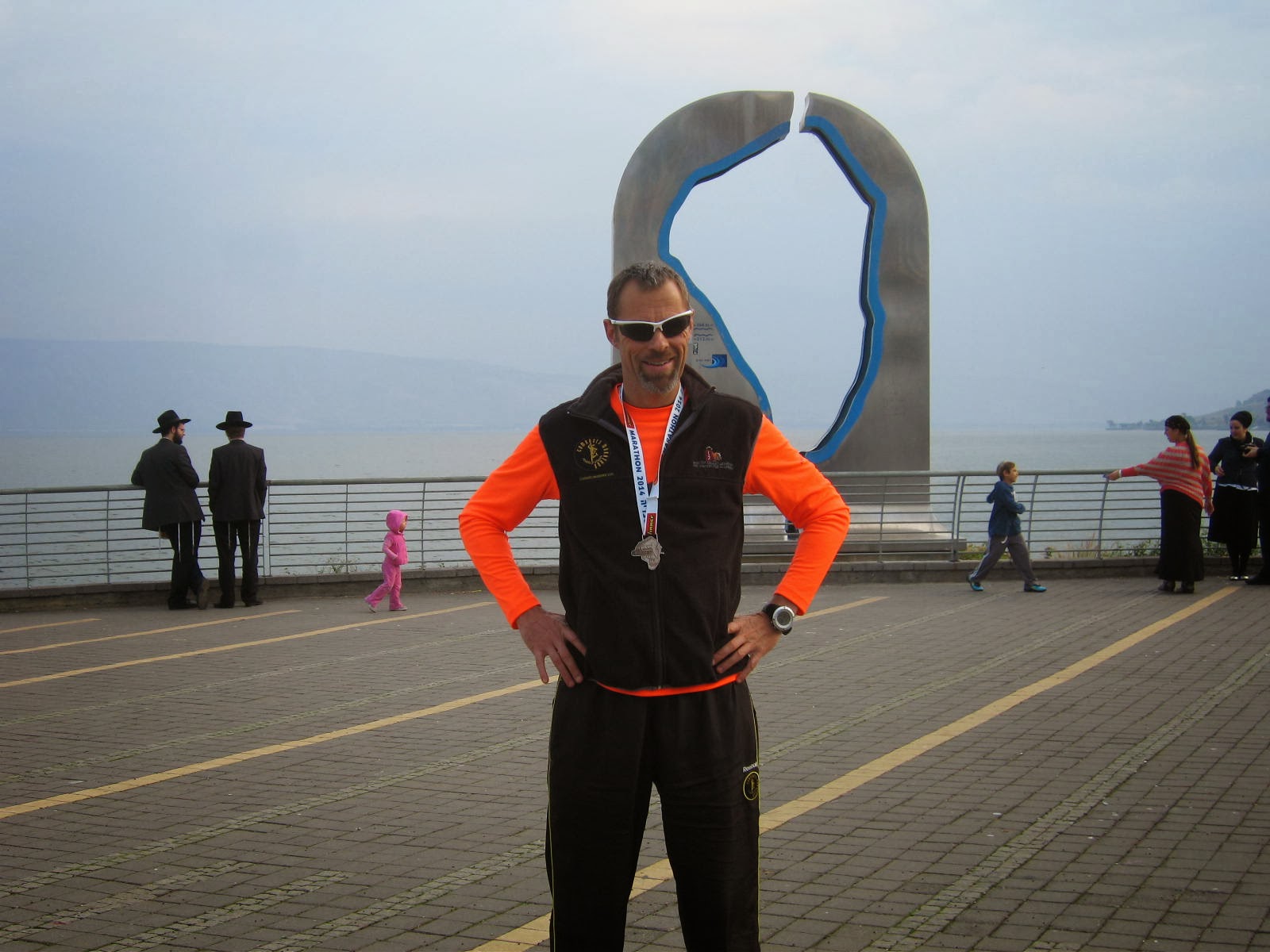
After finishing Tiberias Marathon with its lake and monument 
I started the new running season with the Tiberias Marathon in Northern Israel, on the 10th of January. A finishing time of 3:20 was far above my PR and average time but quite logic given the unspecific training of the previous months and weeks, focussing more on shorter races and trainings. Also the half marathon on Ymmithos mountain, on 2 February was completed in a modest time of 1:50 - 9’ above my PR on that course. My next target is the marathon of Tel Aviv, where I hope to run a bit faster than in Tiberias but certainly not aiming at a PR. One month later I will race for the second time the Jerusalem marathon, only useful for running hills as fast as possible just below the lactate threshold. I also signed up for my second Palestine marathon, 3 weeks later, but I might have to trade if for the 7th World Urban Forum in Medellin/Colombia. No problem, as I have already signed up for something much bigger 2 weeks later, a 144k ultra trail from Tel Aviv to Jerusalem, including some serious hills and rocky trails. 
This should be a serious test for my second participation in the bi-yearly 180,1k long ultra trail race from Ancient Nemea to Ancient Olympia. Two years ago I finished this epic race in just over 20 hours and a shared 3rd position, a completely unexpected result. Looking back to that race I can safely say that all stars were aligned, with cool temps, covered skies, good physical preparation as well a strong mental focus and a large RFE tank, which was regularly refuelled during the race, thanks to the unique journey and the wonderful organisation and race support. I entered the race with the only ambition to reach the finish within the 30h cut off time and I will start with the same ambition this time, regardless the outcome of the first race. My current workload simply doesn't allow the training volume I could achieve two years ago.
The last test before the S-race in September is now staged for Iceland, as I signed up for the 55k Laugavegur Ultra Trail Marathon, together with an Icelandic running friend I have met in Boston.
Now the goal is defined and the milestones are laid down, it’s time to throw in the physical and mental training required to achieve the goal and interim targets. But how much and what kind of  training is required and possible in combination with work and family? When I started training for the classical marathon it was relatively easy to do your homework based on the many training plans available on the running web. This is however different for ultra’s. There are no clear cut training programs for a 144, 180 or 250k ultra. For this kind of ultra-humane performances we are all one of a kind. Some Sparta runners will swear by high mileage training - up to 200k per week or more - others will make it to the finish with a much lower weekly mileage. Some will incorporate speed and tempo workouts, others will simply log the miles at even pace. Some will train to walk, others wont. Some will run many B and C races, others will only focus on the one and only A race. The only common denominator I can see  - more clearly now after reading UltraStu’s RFE theory - is the high amount and importance of mental training to get prepared for races of 100 miles and more. In case of the Spartathlon and other daunting ultra’s I have wondered why runners deemed less fit than me could finally make it to the finish. In one of my previous blogs I even alluded to crypto-religious dimensions I believed key in the determination of some of the finishers, as if running to Sparta is a kind of post-modern pilgrimage. Now I am convinced it has more to do with mental focus than with religion per se, which is a relief for a secular humanist like me. 
Except (or better said part of) of physical and mental training there are two other new year resolutions I have made to reach my goals: pick up reading/writing on running and optimising my body composition and fuelling. By writing this blog and reading/implementing Tim Noakes’ new theory on nutrition - The Real Meal Revolution - I hope to hit both flies with one hand. 
Will keep you posted.

Frank D’hondt,
February 2014, 
Athens-Jerusalem

Follow me also on Facebook

Tuesday, December 18, 2012


Running Around

Autumn Running Report

Running out of 2012


On 12.12.12. - the last double digit day before 3001 - I ran 12k. Only 12 km. There was no point in running more. Four days earlier I’ve ran 121,6 km or 75,5 miles in 12 hours. In a stadium. The stadium of Megara, the ancient city between Athens and Sparta, where I’ve passed along some months earlier on my debut Spartathlon. In laps of 400m. That makes ‘running around’ 312,5 times the same lap. It was my first 12 hour race on track. And, I finished second overall, after my friend Leonidas, but first in my age group of M45 (and according to the 'Deutsche Ultramarathon Vereinigung' my 'age graded performance' was 134,4 km). This year 'Running King Leonidas' surprised many by running further, higher AND faster, with sub 2:50 marathons and winning a mountain race and a 100 miler. And now also a 12 hour race. These are considered to be very different running disciplines and usually you have to sacrifice speed to run farther or longer. Not Leonidas, now aiming to run a new PR on the Boston marathon and to finish a debut Spartathlon. These two races also happen to figure high on my running calendar for next year - yes I do remember to have said I probably won’t run Spartathlon again - so it looks like we’ll stay connected

[By the way, friendship is one the best merits of ultra-running. Paradoxically, whilst running - and ultrarunning in particular - is considered to be highly individualistic - it does create strong bonds among peers. The reason is quite simple: only (ultra)runners know what its like to take joy and understand the meaning of ‘pain’. While the modern (wo)man is taught to avoid pain and suffering, running can get you back on the healthy track of learning and benefitting from pain. Sunshine after rain always feels nice, no? Same with running. You simply feel better after stressing your body and mind, or at least you appreciate more the true happiness of ‘feeling alive’. This can be for a short distance with high intensity; it will be for sure the case after a long distance, regardless the intensity. I will never forget the last 20k with Odysseas at Olympus Marathon, nor the last 40k with Dinos at the Olympia Race. But ‘joy after pain’ is not always for granted. Often its just ‘pain after pain’; you’ll have to risk it, again something we try to avoid in our modern lives. And when you engage your self in races where all participants take the risk to aim for joy through and after pain, you feel connected by default. That simple!]

My preparation for the 12 hour race was certainly not very race-specific. Since the (the first leg of) Spartathlon of end September I didn’t run run any longer distance non-stop than 52k, when I completed a training run from Athens to Sounio, along the Attic riviera. Moreover, since completing my sixth Athens Classic Marathon in November (see further), I didn't ran any further than 20k and I even included a biking week on the beautiful island of Naxos, where I’ve logged around 250 km to marvel the nice beaches and - of course - climb its highest mountain , Mount Zas (or Zeus), with a cave at the base where mighty Zeus allegedly was raised (so now I have seen where he was born - in a cave on Psiloritis mountain in Crete - where he was raised and where he reigned over his kingdom - Mount Olympus of course - and even where he was worshipped most - Ancient Olympia). As a matter of fact, two weeks before the Athens Classic Marathon, I had started a 24 week training plan for the Boston marathon, due to be held on 15 April, and to which I happily qualified to participate. Upon personal advice of my favorite running author, Matt Fitzgerald (‘Brain training for Runners’ and other great books runners should consult), I also included more advanced strength training, engaging a personal trainer, my friend Kostas Rigas, who is also running marathons, but much faster (2:40 something in Berlin last year). The strength trainings are twice a week, on Tuesday and Thursday, and include upper and lower body workouts which leave you ‘joyfully’ exhausted and or sore. 

Therefore, the Athens Classic Marathon wasn't meant to be a hunt for a personal best, rather a training and just for the fun of starting and finishing it with some of my best running friends.  However, once the start-gun went of for the 30th time, you go with the flow of the day. The weather conditions were not as favorable as last year but still fairly good for marathon racing. I kept a decent pace throughout the race, didn't push too hard on the hills between 15 and 30k and could open the turbo for the last 10, finishing for a sixth consecutive time in the magic Kalimarmaro Olympic stadium after 3 hours and 3’, 12th overall on 9000 something participants but - surprisingly - second in my age group (M45-49); however acknowledging that there were much faster men above 50! It also turned out to be my fastest marathon of this season, so good reasons to be satisfied with this unexpected result. And what a great feeling to walk away with no pain after the race, to run a 5k recovery run the next day and resuming the training schedule as nothing has happened the following days. Apparently my body (and mind) got used to the abuse, at least for marathon distances. 


[I am a marathon runner
And my legs are sore
And I'm anxious to see what I'm running for
From the song “Marathon Runner”, performed by Yellow Ostrich (nice song by the way)]


So, less than one month after the Athens Classic, I drove to Megara, at 5am. The race started timely at 7am and the first 10-20-30km ticked away ‘easily’, largely helped by the gorgeous weather with cool temps, a watery sun and almost no wind. This however changed throughout the day with more wind and rain in the later stages of the race. The thought of running hundreds of laps was intimidating before the race but I’ve decided to block out any negative thought during the race, which worked pretty well.  The downtempo lounge chill out music on my mp3 also helped in keeping the pace steady, lap after lap. The first half of the race hours you run together with the 6 hour runners, so you have no clear idea of your position, although it was pretty clear from the start that Leonidas would reign sovereignly over his kingdom - by moments he was like flying around the stadium. And flying would surely be better than running on this soft tartan, which might be good for running a couple of laps but not for hours in a row - simply too bad for your joints. Already after 2 hours I felt pain around the right knee, due to an imbalanced running gait. Luckily, running direction is switched every 3 hours, so pain only returned around the other knee some hours later. After 6 hours, joints were sore at both sides, so the pain was better balanced. The first half you run with your legs and lungs, the second half you have to rely much more on heart and mind. The mind in particular. I needed to improvise a strategy to keep turning around like a hamster. I decided to try this: run 10 laps in a steady pace before taking a short break to eat, drink and stretch. It worked until the very end for me. I even could eat some home made pumpkin pie and try out chocolate flavored soya milk and vanilla flavored rice-milk, as a very welcome alternative for the sweet isotonic drinks and cola usually consumed during ultra’s. Moreover, the breaks in between the 10 laps-lap shortened in time towards the end. I probably owe this to my friend Ioannis, who was managing the time-keeping of the race and informing me about my position: “you are second but the third runner is closing the gap on you”. Although I only started this race with the aim to keep running for the entire 12 hours and if possible to run at least 110 km, my my competitive mode was aroused and once I figured out who was the 3rd runner, I didn't let him come any closer anymore, quite the reverse. Towards the very end some runners seemed to have tapped into a reserve tank and they were passing me several laps, up to a point I wasn't so sure anymore about my final position. Yet it became clear they picked up the pace too late and when the long awaited whistle ended the race, I was confirmed to have finished in second position, while my much appreciated Suunto Ambit watch showed no less than 125 km running, an average of 10,5 km/h for 12 hours. Despite the sore legs and cripple knees, it felt good to climb the podium, next to king Leonidas, and to be awarded with a special medal and a cup. Immediately after the award ceremony - and not able to drink or eat anything - I drove back home in agony. Also back home I could not take food but a Belgian brew provided just enough carbs and painkiller to make it to the bed. All night long I turned and tossed, and next morning I could hardly walk on a heavily swollen knee. So in this case, similar to my successful first 100k race earlier in this season, it turned out to be a pain-joy-pain sequence. Nevertheless I resumed my strength training on Tuesday (focusing on upper body thank god) and felt nearly euphoric to be able to run the next day, the 12k on 12.12.12 I’ve mentioned at the intro. 

[By the way, I finished the Megara race on baby-feet, with no blisters at all. Quite a pleasant surprise I can tell you. I ran the entire race in my Asics Noosa Tri shoes, those multicolored flashy ones often used by triathletes for their final marathon leg. I’ve tried them  for the first time during the 24 hour Athens Running Festival in March but soon developed some hot spots, that would have turned into blisters if I didn't quit halfway. Later in the season I also used them for long training runs, but experienced problems with the elastic laces that are used by triathletes for easy transitioning. Only after replacement by normal laces I could fully enjoy the greatness of this shoe; a performance shoe with a relative low heel drop but sufficient cushioning.  Throughout this season I have tried many different types and makes of running shoes, but mostly lighter and more minimalistic shoes. In earlier reports I already acclaimed Nike’s Free 3’s, but this year edition(s) dont fancy me that much, although, for the first time, I managed to run a marathon race in them. I’ve also tried the Nike Free 5 for longer distances - only once before they were never returned with my drop-bag by the Spartathlon organizers - but no thanks. The Merell Access barefoot was a better match, especially on trails. Also the Sketchers GoBionic is a real minimalist footwear compared to Nike Free: super lightweight, zero heel drop and super flexible. However I don't see myself running long distances or technical trails in them; they are more suitable for light training as well for recreation purposes (walking and even going out). For the trails I’ve also tried out two Inov8 models, the XT Tallon 212, which is a very lightweight trail shoe with decent traction, and the Mudclaw, which is more rugged and better suited for mountain runs. My shoe of the year however is the Saucony Kinvara 2, so not the latest model. This shoe is for me the perfect compromise between minimalist and more traditionally cushioned footwear. As stocks are running out, I ordered three pairs to be safe for a while, in white, black and red uppers. Saucony is not by coincidence one of the few brands only specialized in running sports. One last remark about running shoes: its probably even more important to improve your running gait and the pounding of the feet in particular, especially for longer distances. Minimalist shoes helped me to transition from heel striking to horizontal mid-foot landing. I don't see the point of fore-foot striking, but mid-foot substantially reduces the pounding of the feet and the shock to absorb by the tendons, calf muscles and knees. Once your running gait is bullet-proof, you can probably race in any kind of shoe.]

Happy endings in both the Athens Classic Marathon and the Megara 12 hour race in particular flushed away doubts that had crept into my mind after a unsuccessful debut at a 24 hour race (Athens Ultramarathon Festival) in March and the Spartathlon in particular. Already in October I've reported on the Spartathlon race on this blog. The Megara race - similar to the successful Olympia 180k Trail race earlier this year - confirmed once more that my body performs optimal in cool weather conditions and that heat is my worst enemy.  However, paraphrasing Stephen Kaggwa’s famous quote, “Try and fail, but don't fail to try (again).”. That’s why I have decided to give Spartathlon another try. Obviously I will need to develop a strategy to befriend my worst enemy and to further adapt my body to running in heat and humidity. My future work environment might help on that...


Looking back on 2012 - my last race on 30 December, a 12k city-run in Leuven/Belgium won't probably change the overall picture - I can assess this years performances from two different angles. The ‘thumbs down perspective’ is that this year marked the very first season in  which I could not finish some prime races. “Did Not Finish” or DNF in runners lexicon is for many runners the most feared outcome. We accept that most of us cannot outright win races, so finishing a race is the most important motivation to appear at the start in the first place. Until 2012, I never ‘DNF-d’ a race. But if you constantly push the boundaries of your limits, one day it has to happen. It happened the first time with the 24 hour Athens Ultrarunning Festival, where I pulled out the race after ‘only’ 96 km and 11,5 hours of running. However, technically I didn't DNF here, as the records just memorize that I’ve ran 96k in 24 hours. The first ‘real’ DNF came with the 100k Olympus Mythical Trail race. There I handed in my bib number after 62 km and about 12 hours, with at least the same amount of time ahead of me if i could and wanted to finish. I believe I could have done it, but for the first time I didn't want it, because I couldn't see the joy through or beyond the pain. One of the reasons was for sure the heat in the lower parts of the race, which I couldn't cope with very well. This race was planned as a serious training for the Spartathlon and I also didn't want to risk any serious injury by overstraining my joints only 2,5 months before THE race. However, it didn't really help, as I also DNF-d the infamous 246 km long Spartathlon. Of course, how could I know that I would participate in probably the hottest edition ever, with less than 25% of the qualified and experienced runners crossing the finish line in this ‘historical’ 30th edition. Lesson of all this: finally I seem to have found my limits. Maybe not absolute physical limits but rather limits in overruling my will to stop when exhausted or in pain. And I’m not unhappy with this ‘new reality’. I was looking for races that are difficult to finish and I’m happy to have found them. 


But this year was also marked by three podium places in ultraraces I could never dream to ever participate, let alone to finish some years ago. The fist surprise came with my first attempt to run 100 km, in Psatha-Aleppochori in February, finishing 7th overall and first in my age group M45, in 8 hours 57’, more than 90’ faster than the official qualification time for the Spartathlon (read  more in Running Diaries Nr 4). The second and to date biggest surprise came with the Olympia Trail Race in May, a 180,1 km long race over roads and trails, including mountain passes and river crossings. So longer than a classic 100 miler, the ‘standard distance’ for ‘real ultra-runners’. Starting the race with the sole ambition to finish, I surprised myself and others by claiming a shared 3rd place and a first age group ranking in 20 hours and 14’ (read more in Running Diaries Nr 5). Olympia Race added a holistic new experience to my (short) running career, with a nice crystal trophy that will remind me forever the beauty of running in tune with body and nature. With this result I was supposed to be able to finish Spartathlon, even within a decent time. But on my way to Olympia I had the weather gods on my side, while on the way to Sparta they turned against me. In Megara however, I was lucky again with the weather but nevertheless I didn't expect to finish second, let alone to run the 117th best time overall and 27th in M45 in this discipline worldwide (see http://statistik.d-u-v.org) And of course I ran many other races and no less than 5 official marathons (Limassol in Cyprus, Antwerp and Torhout in Belgium, Jungfrau in Switzerland and finally the Athens Classic for a 6th consecutive time), in a consistent time of around 3 hours and 5’ (with exception of the Jungfrau mountain marathon - with probably the most beautiful mountain run finish in the world) and with the last one as the best performance (3:03). In Limassol I finished 13th overall and 1st in my age group, while in the Athens Classic I finished 126th overall and 2nd in my age group. Three ultra-running cups and some nice age group rankings in ‘ordinary’ marathons is a result beyond my expectations. Moreover, I could run many races and debut in ultra-distances without any serious injury, including daily training and some long and adventurous training runs, and that’s the biggest cup you can earn at the end of a long and intensive season. 

The combined main lessons learned from both the failures and successes is that a) nothing is for granted and b) nothing is impossible. Therefore I have challenged myself for next year - while ‘proudly’ entering the age group M50 - with two targets: a) running faster than ever and b) running farther than ever. 


Boston marathon will be the prime race to achieve the first goal, while there can’t be any other more challenging race than Spartathlon to achieve the second goal. Luckily the two races are well apart in time, so my training can be easily modulated around those two prime races. Of course I have more races on the radar for 2013, but except of the Jerusalem Marathon on 1 March - making it the first upcoming marathon race - I have not yet paid any race fees, not knowing how the next year will envelop work-wise, as new horizons are looming. 2013 should also mark a breakthrough for a 'running related project' on which I have been working quite intensively the last few months, but that has to remain a mystery until the team is ready to launch 'it'. All this provided the world will NOT stop spinning around by 21.12.12., as predicted by some of our species. If so, I’m glad I took all what I could take in this ending year. I hope you did the same and if not (entirely), I hope there will be a new year in a different world to try again, fail again, then try again, but never fail to try (again)! 


Frank D’hondt,  Athens, 20.12.12 

Wednesday, October 3, 2012


Race Report


“Try and fail, but don't fail to try.”
Stephen Kaggwa


            For those who don't know or remember well, SPARTATHLON is a historic ultra-distance foot race that takes place every year in September in Greece. It is one of the most tough and iconic ultra-distance races in the world because of its course and unique history. The Spartathlon revives the footsteps of Pheidippides, an ancient Athenian long distance soldier-messenger, who in 490 BC, before the battle of Marathon, was sent to Sparta to seek help in the war between the Greeks and the Persians. According to the ancient Greek historian Herodotus, Pheidippides arrived in Sparta the day after his departure from Athens. Inspired by the report of the Greek historian, in 1982 five officers of the British Royal Air Force (RAF), who were also long-distance runners, traveled to Greece, led by Colonel John Foden. Their purpose was to test whether it was possible to cover the 250 kilometers separating the two towns in one and a half days. The enthusiastic British team showed that the report by Herodotus was entirely plausible, with finishing times under 40 hours. After the success of the project, John Foden began to envision the establishment of a race that would bring long distance runners to Greece from around the world to run on the trail of the ancient runner Pheidippides. In 1983 a multinational team of British, Greek and other supporters of the idea organized the First Open International Spartathlon Race, wherein the name for the race combines the Greek words for Sparta and Feat. 

The Spartathlon route of nearly 250km to be covered in less than one day and a half

2012 marked the 30th anniversary of this legendary race and it would prove to become a historical one for the following reasons: 

a) it was probably the hottest and toughest edition ever, with a merciless sun and temperatures around 35 degrees Celsius, high humidity and hardly wind to ventilate the burning running corpses and legs;
b) it turned out to become the edition with the lowest finish rate, with less than 25% (72) of all starting athletes (310) reaching the statue of King Leonidas at Sparta;
c) nevertheless a record was broken! The fabulous British Lizzy Hawker finished in 27:02:17,  more than 37' faster than the standing female course record AND a third finishing position overall, shortly after the German winner Thoms Stu and the Japanese Kiso Tetsuo;
d) of no importance for the race records but all the more for my records: this was the first race I really wanted but DID NOT FINISH (DNF), simply because of the heat. Or maybe not that simple, as I will explain further!

Although I did not run much farther than to the end of the first leg in Istmia, just across the impressive canal of Corinth, it's enough to share some impressions and learn some valuable lessons. 


Me at the start, flanked by Giorgos Panos (R) and Giogios Zachariadis (L), both finishers at Sparta

Despite a scrambled tapering period due to an unexpected travel to Belgium and back right before the start of the race, I dressed up Friday morning at 5am, with enough confidence to make it to the finish. The start at the Acropolis at 7am, surrounded by peers and supporters added some more adrenaline but I kept my coolness not to head out too fast. Only 20km in the race I started to pick up slower runners and really feeling 'fresh' way beyond the first marathon mark of 42,2km. Despite the agonizing course with heavy traffic rushing towards the capital city, there were pleasant moments of chatting with ultra-running friends from all over the world, of whom many from the Olympia Ultra Trail race (180,1km), where I finished 4th in May this year (see Spring Running report). A critical point was the second uphill, where I 'cracked' during a training run in Mid-August, but this time I could simply keep running while many others were already forced to a brisk walk. Even the point where I've quit my training attempt to reach Corinth, at the 57km mark, I passed with an indestructible feeling. However, by that time the sun was really burning and my core-body temperature was definitely on the rise. Water and sponges were available, as well drinks but all heated up by the sun, so missing the point actually. 


Me at check-point 11 around the first marathon mark, trying to resist the heat

Around 60km I BOUGHT a real refreshing soft drink and a bit later another one. However, it felt like trowing cold water on a steaming radiator of an overheated car, thus only producing more steam. My pace gradually decreased and soon I found myself walking hilly as well flat stretches. The sun seemed to shine even harder and I couldn't resist resting a couple of times in the shade of a tree or in a bus shelter. It felt like the sun had poisoned my legs, lungs and heart and the exhaust of cars and refining industries along the course did not help to fight and resist this process. I saw my comfortable margin vis-a-vis the feared cut-off times melting away and volunteers at check-points urged me to keep on going not to miss the strict deadline at CP 22, at 80km distance in the race. The combination of the cut-off stress with soaring heat, burning legs and lunges, aggressive traffic and dull scenery sapped away the last joy of running and negative thoughts were gradually damping out the pool of confidence, up to a point I had to persuade myself to AT LEAST run-walk to CP22. IF I could make it within the cut-off time of 9,5 hours, and IF I might pick-up a second wind just before entering the aid-station, MAYBE I could make it to the next check-point and than see again. So I had to dig deep to keep going and although I was hardly running anymore, there weren't that many runners overtaking anymore, which meant they either had given up already or they would face great difficulty to reach CP22 on time. I hoped for a second wind when I finally crossed the canal of Corinth, a well-known point in the Spartathlon, as well a geographical landmark entering the Peloponnese, the 'homeland' of Sparta. But the wind was of short breath when I entered the devastating motorway leading to CP22. 

When I finally arrived at CP22, at 16h20, I thought I only had 10' left before closing time, too short for a decent recovery as I've had planned before the race. When I realized I couldn't even push down some food and liquids anymore, I know I was doomed - despite the extra time of 30' before closing. Nevertheless my Belgian friends Jan and Marc initially succeeded to get me going again and head out to the next CP. But hardly one 1km further I felt like a roasted chicken running around without head, and without much thinking (obviously), I could not overrule my feet turning around and RUNNING BACK to CP22, to simply hand over my bib numbers and my chip, which means a definitive end to the race. However I must admit that my brain simply calculated that CP23 or any further simply adds complexity in finding a way out of this race. A more serious calculation was that the heat at 4.30pm was far from declining and that IF I would make it through the next 3 hours of solar torture, I will have to face it another 10 to 12 hours the next day, which was an unbearable thought. 

One hour after my decision to surrender, I was lucky to be driven back home by my friend Dimitris, who was actually on his way to support me through the second and third leg of the race. When Dimitris asked me I would retry next year, I simply answered NO WAY. I told him I simply didn't like this race, that the course is far from enjoyable and that the organization of aid-stations and traffic control was far from the standards I am used to in international races. These critical reflections were later mirrored by the first hand assessment of my friend Leonidas, who followed Lizzy Hawker from start to finish (see his blog report on http://polyenios.blogspot.gr). Leonidas concluded that the organization of the race should try to improve several aspects so that this race becomes an "ambassador" of Greece to ultrarunning community, more in particular (among others)that the organization should try to control or minimize road traffic (one way traffic, cones, more traffic police), that check points should be accessible only to those involved in the race, and last (but least likely) that the organizers should also consider modifying the course to include some forest/agricultural roads if this would keep the runners out of motorways.


Lizzy Hawker on het way to a new female course record and a 3rd position overall

Leonidas also touched one other cardinal aspect: that of mind over body."This race is the most profound proof that these distances are conquered only with the brain and the heart, and not by physical training only. The real challenge of Spartathlon is not the distance or the strict cut off times. It is the mental and emotional difficulties that each runner has to overcome in order to arrive at Sparta."  Leonidas is right on that, but my experience is that its all about the BALANCE and the INTERACTION between legs, heart and brain. If legs are severely cramping due to critical loss of electrolytes, a strong heart or mental focus will probably not compensate. In my case it was not about cramping but probably a gradual increase in body temperature due to a natural high sweat rate and lack of cooling options at the aid stations. Sweat rate and heat management can be improved by specificity training, but is to a large extent genetically determined. It is my guess that the 72 finishers were not only extremely well prepared but also owe a lot to their ancestors' DNA. Some try to help nature a hand by investing time and money to find specialized gear for running in the heat. I saw some naked torso's - I don't believe this can be helpful - but most runners were 'normally' dressed up while a minority ran with covered limbs, mostly white but some entirely black. Yet, among the finishers they were not disproportional represented so I don't think that this is THE answer or strategy. As with shoes and other auxiliary gear it is probably a very personal and individual issue and quest for what works best for you, mainly by trial and error. Even the placebo-effect can be worth trying different things. 

Leonie Van den Haak and mom running to Leonidas statue

Coming back to the mind over body issue, I was struck by the race feedback from Leonie Van den Haak, a Dutch female runner finishing 8th overall in her debut. I know Leonie as a FB-friend since some months now and I followed her preparation for the race. She's not only gifted as a natural born ultra runner; she's not only training hard and racing often as most of the Spartathlon starters - what made this tiny white runner excelling is probably her mental focus, determination and almost naive enthusiasm. Since her qualification and registration, the Spartathlon was the only thing that mattered and she created a lot of positive pressure around her, including from a mainstream sporting sponsor. Yet, as soon the starting gun went of, she was determined to enjoy every moment of what she wanted to achieve all that time. And she did. The moment she passed me around 60km, the time I was entering the dangerous path of negative thinking, she was still one big smile. The sun was also burning on her skin, yet it didn't seem to bother her - more likely: she didn't want to be distracted by this 'detail'. And because she was able to maintain the positive momentum, she could gradually climb up in the ranking to finish 2nd female after the much more experienced Lizzy Hawker. As a matter of fact, I believe that all 72 finishers could only make it because they did not allow their mind to take stock of the suffering body and simply block out negative thinking. For some of the finishers - some of them I know personally - it was almost a matter of life or death, which is a simple choice for a healthy well trained athlete. 

Georgios Zachariadis chased by traffic police to finish last of the 72 finishers, less than 4' before closing time

For some, the Spartathlon is nothing less than a kind of pilgrimage or a journey or search of moral or spiritual significance. Typically, it is a journey to a shrine or other location of importance to a person's beliefs and faith, although sometimes it can be a metaphorical journey in to someone's own beliefs - the place of their "calling" or spiritual awakening. In mainland Greece, a stream of individuals made their way to Delphi or the oracle of Zeus at Dodona, and once every four years, at the period of the Olympic games, the temple of Zeus at Olympia formed the goal of swarms of pilgrims from every part of the Hellenic world. When Alexander the Great reached Egypt, he put his whole vast enterprise on hold, while he made his way with a small band deep into the Libyan desert, to consult the oracle of Ammun. It is my impression that for some the statue of King Leonidas in Sparta, a historical figure but with no direct relation to Pheidippides or the origins of the Spartathlon, represents a post-modern shrine or oracle. The fact that some also run with a large tattoo of the Spartathlon logo on their calf is probably also a sign of a soul-searching (and finding). That probably also explains why many 'Spartathletes' refuse to criticize the race, although there are plenty of reasons if you consider it objectively. 

Andreas Falk from Sweden, realizing to have finished in 5th position in just under 28 hours

So, IF I would retry to run from Athens to Sparta on this given course, the single most important strategy will be to immerse myself in the 'beauty' of this 'beast', with the indestructible will of Alexander the Great to consult the oracle of Ammun as a matter of life or death, of victory over defeat. And although I've declared already NOT to come back, the award ceremony and some incremental introspective thinking are pushing the needle back to a MAYBE. IF I'm able to get the mental focus sharper than ever before on REACHING SPARTA, then "maybe" will probably become ...PROBABLY. 

For the time being I will now focus on the remaining task for this running season, to complete the last leg of Pheidippides epic runs, from Marathononas to Athens, in other words the Athens Classic Marathon, on Sunday 11 November. Finishing should not be a real issue, since it will be the sixth consecutive time I'll run this race. Finishing as fast as possible after a transition year from marathon to ultra-marathon running; that will remain a challenge. 


Frank D'hondt
Athens
3 October 2012

PS: my sincere congratulations to all finishers of Spartathlon 2012, including two of the seven participating Belgian compatriots, Stefaan D'Espallier(39th)and Rony Jansen(60th).