Wednesday, October 3, 2012


Race Report


“Try and fail, but don't fail to try.”
Stephen Kaggwa


            For those who don't know or remember well, SPARTATHLON is a historic ultra-distance foot race that takes place every year in September in Greece. It is one of the most tough and iconic ultra-distance races in the world because of its course and unique history. The Spartathlon revives the footsteps of Pheidippides, an ancient Athenian long distance soldier-messenger, who in 490 BC, before the battle of Marathon, was sent to Sparta to seek help in the war between the Greeks and the Persians. According to the ancient Greek historian Herodotus, Pheidippides arrived in Sparta the day after his departure from Athens. Inspired by the report of the Greek historian, in 1982 five officers of the British Royal Air Force (RAF), who were also long-distance runners, traveled to Greece, led by Colonel John Foden. Their purpose was to test whether it was possible to cover the 250 kilometers separating the two towns in one and a half days. The enthusiastic British team showed that the report by Herodotus was entirely plausible, with finishing times under 40 hours. After the success of the project, John Foden began to envision the establishment of a race that would bring long distance runners to Greece from around the world to run on the trail of the ancient runner Pheidippides. In 1983 a multinational team of British, Greek and other supporters of the idea organized the First Open International Spartathlon Race, wherein the name for the race combines the Greek words for Sparta and Feat. 

The Spartathlon route of nearly 250km to be covered in less than one day and a half

2012 marked the 30th anniversary of this legendary race and it would prove to become a historical one for the following reasons: 

a) it was probably the hottest and toughest edition ever, with a merciless sun and temperatures around 35 degrees Celsius, high humidity and hardly wind to ventilate the burning running corpses and legs;
b) it turned out to become the edition with the lowest finish rate, with less than 25% (72) of all starting athletes (310) reaching the statue of King Leonidas at Sparta;
c) nevertheless a record was broken! The fabulous British Lizzy Hawker finished in 27:02:17,  more than 37' faster than the standing female course record AND a third finishing position overall, shortly after the German winner Thoms Stu and the Japanese Kiso Tetsuo;
d) of no importance for the race records but all the more for my records: this was the first race I really wanted but DID NOT FINISH (DNF), simply because of the heat. Or maybe not that simple, as I will explain further!

Although I did not run much farther than to the end of the first leg in Istmia, just across the impressive canal of Corinth, it's enough to share some impressions and learn some valuable lessons. 


Me at the start, flanked by Giorgos Panos (R) and Giogios Zachariadis (L), both finishers at Sparta

Despite a scrambled tapering period due to an unexpected travel to Belgium and back right before the start of the race, I dressed up Friday morning at 5am, with enough confidence to make it to the finish. The start at the Acropolis at 7am, surrounded by peers and supporters added some more adrenaline but I kept my coolness not to head out too fast. Only 20km in the race I started to pick up slower runners and really feeling 'fresh' way beyond the first marathon mark of 42,2km. Despite the agonizing course with heavy traffic rushing towards the capital city, there were pleasant moments of chatting with ultra-running friends from all over the world, of whom many from the Olympia Ultra Trail race (180,1km), where I finished 4th in May this year (see Spring Running report). A critical point was the second uphill, where I 'cracked' during a training run in Mid-August, but this time I could simply keep running while many others were already forced to a brisk walk. Even the point where I've quit my training attempt to reach Corinth, at the 57km mark, I passed with an indestructible feeling. However, by that time the sun was really burning and my core-body temperature was definitely on the rise. Water and sponges were available, as well drinks but all heated up by the sun, so missing the point actually. 


Me at check-point 11 around the first marathon mark, trying to resist the heat

Around 60km I BOUGHT a real refreshing soft drink and a bit later another one. However, it felt like trowing cold water on a steaming radiator of an overheated car, thus only producing more steam. My pace gradually decreased and soon I found myself walking hilly as well flat stretches. The sun seemed to shine even harder and I couldn't resist resting a couple of times in the shade of a tree or in a bus shelter. It felt like the sun had poisoned my legs, lungs and heart and the exhaust of cars and refining industries along the course did not help to fight and resist this process. I saw my comfortable margin vis-a-vis the feared cut-off times melting away and volunteers at check-points urged me to keep on going not to miss the strict deadline at CP 22, at 80km distance in the race. The combination of the cut-off stress with soaring heat, burning legs and lunges, aggressive traffic and dull scenery sapped away the last joy of running and negative thoughts were gradually damping out the pool of confidence, up to a point I had to persuade myself to AT LEAST run-walk to CP22. IF I could make it within the cut-off time of 9,5 hours, and IF I might pick-up a second wind just before entering the aid-station, MAYBE I could make it to the next check-point and than see again. So I had to dig deep to keep going and although I was hardly running anymore, there weren't that many runners overtaking anymore, which meant they either had given up already or they would face great difficulty to reach CP22 on time. I hoped for a second wind when I finally crossed the canal of Corinth, a well-known point in the Spartathlon, as well a geographical landmark entering the Peloponnese, the 'homeland' of Sparta. But the wind was of short breath when I entered the devastating motorway leading to CP22. 

When I finally arrived at CP22, at 16h20, I thought I only had 10' left before closing time, too short for a decent recovery as I've had planned before the race. When I realized I couldn't even push down some food and liquids anymore, I know I was doomed - despite the extra time of 30' before closing. Nevertheless my Belgian friends Jan and Marc initially succeeded to get me going again and head out to the next CP. But hardly one 1km further I felt like a roasted chicken running around without head, and without much thinking (obviously), I could not overrule my feet turning around and RUNNING BACK to CP22, to simply hand over my bib numbers and my chip, which means a definitive end to the race. However I must admit that my brain simply calculated that CP23 or any further simply adds complexity in finding a way out of this race. A more serious calculation was that the heat at 4.30pm was far from declining and that IF I would make it through the next 3 hours of solar torture, I will have to face it another 10 to 12 hours the next day, which was an unbearable thought. 

One hour after my decision to surrender, I was lucky to be driven back home by my friend Dimitris, who was actually on his way to support me through the second and third leg of the race. When Dimitris asked me I would retry next year, I simply answered NO WAY. I told him I simply didn't like this race, that the course is far from enjoyable and that the organization of aid-stations and traffic control was far from the standards I am used to in international races. These critical reflections were later mirrored by the first hand assessment of my friend Leonidas, who followed Lizzy Hawker from start to finish (see his blog report on http://polyenios.blogspot.gr). Leonidas concluded that the organization of the race should try to improve several aspects so that this race becomes an "ambassador" of Greece to ultrarunning community, more in particular (among others)that the organization should try to control or minimize road traffic (one way traffic, cones, more traffic police), that check points should be accessible only to those involved in the race, and last (but least likely) that the organizers should also consider modifying the course to include some forest/agricultural roads if this would keep the runners out of motorways.


Lizzy Hawker on het way to a new female course record and a 3rd position overall

Leonidas also touched one other cardinal aspect: that of mind over body."This race is the most profound proof that these distances are conquered only with the brain and the heart, and not by physical training only. The real challenge of Spartathlon is not the distance or the strict cut off times. It is the mental and emotional difficulties that each runner has to overcome in order to arrive at Sparta."  Leonidas is right on that, but my experience is that its all about the BALANCE and the INTERACTION between legs, heart and brain. If legs are severely cramping due to critical loss of electrolytes, a strong heart or mental focus will probably not compensate. In my case it was not about cramping but probably a gradual increase in body temperature due to a natural high sweat rate and lack of cooling options at the aid stations. Sweat rate and heat management can be improved by specificity training, but is to a large extent genetically determined. It is my guess that the 72 finishers were not only extremely well prepared but also owe a lot to their ancestors' DNA. Some try to help nature a hand by investing time and money to find specialized gear for running in the heat. I saw some naked torso's - I don't believe this can be helpful - but most runners were 'normally' dressed up while a minority ran with covered limbs, mostly white but some entirely black. Yet, among the finishers they were not disproportional represented so I don't think that this is THE answer or strategy. As with shoes and other auxiliary gear it is probably a very personal and individual issue and quest for what works best for you, mainly by trial and error. Even the placebo-effect can be worth trying different things. 

Leonie Van den Haak and mom running to Leonidas statue

Coming back to the mind over body issue, I was struck by the race feedback from Leonie Van den Haak, a Dutch female runner finishing 8th overall in her debut. I know Leonie as a FB-friend since some months now and I followed her preparation for the race. She's not only gifted as a natural born ultra runner; she's not only training hard and racing often as most of the Spartathlon starters - what made this tiny white runner excelling is probably her mental focus, determination and almost naive enthusiasm. Since her qualification and registration, the Spartathlon was the only thing that mattered and she created a lot of positive pressure around her, including from a mainstream sporting sponsor. Yet, as soon the starting gun went of, she was determined to enjoy every moment of what she wanted to achieve all that time. And she did. The moment she passed me around 60km, the time I was entering the dangerous path of negative thinking, she was still one big smile. The sun was also burning on her skin, yet it didn't seem to bother her - more likely: she didn't want to be distracted by this 'detail'. And because she was able to maintain the positive momentum, she could gradually climb up in the ranking to finish 2nd female after the much more experienced Lizzy Hawker. As a matter of fact, I believe that all 72 finishers could only make it because they did not allow their mind to take stock of the suffering body and simply block out negative thinking. For some of the finishers - some of them I know personally - it was almost a matter of life or death, which is a simple choice for a healthy well trained athlete. 

Georgios Zachariadis chased by traffic police to finish last of the 72 finishers, less than 4' before closing time

For some, the Spartathlon is nothing less than a kind of pilgrimage or a journey or search of moral or spiritual significance. Typically, it is a journey to a shrine or other location of importance to a person's beliefs and faith, although sometimes it can be a metaphorical journey in to someone's own beliefs - the place of their "calling" or spiritual awakening. In mainland Greece, a stream of individuals made their way to Delphi or the oracle of Zeus at Dodona, and once every four years, at the period of the Olympic games, the temple of Zeus at Olympia formed the goal of swarms of pilgrims from every part of the Hellenic world. When Alexander the Great reached Egypt, he put his whole vast enterprise on hold, while he made his way with a small band deep into the Libyan desert, to consult the oracle of Ammun. It is my impression that for some the statue of King Leonidas in Sparta, a historical figure but with no direct relation to Pheidippides or the origins of the Spartathlon, represents a post-modern shrine or oracle. The fact that some also run with a large tattoo of the Spartathlon logo on their calf is probably also a sign of a soul-searching (and finding). That probably also explains why many 'Spartathletes' refuse to criticize the race, although there are plenty of reasons if you consider it objectively. 

Andreas Falk from Sweden, realizing to have finished in 5th position in just under 28 hours

So, IF I would retry to run from Athens to Sparta on this given course, the single most important strategy will be to immerse myself in the 'beauty' of this 'beast', with the indestructible will of Alexander the Great to consult the oracle of Ammun as a matter of life or death, of victory over defeat. And although I've declared already NOT to come back, the award ceremony and some incremental introspective thinking are pushing the needle back to a MAYBE. IF I'm able to get the mental focus sharper than ever before on REACHING SPARTA, then "maybe" will probably become ...PROBABLY. 

For the time being I will now focus on the remaining task for this running season, to complete the last leg of Pheidippides epic runs, from Marathononas to Athens, in other words the Athens Classic Marathon, on Sunday 11 November. Finishing should not be a real issue, since it will be the sixth consecutive time I'll run this race. Finishing as fast as possible after a transition year from marathon to ultra-marathon running; that will remain a challenge. 


Frank D'hondt
Athens
3 October 2012

PS: my sincere congratulations to all finishers of Spartathlon 2012, including two of the seven participating Belgian compatriots, Stefaan D'Espallier(39th)and Rony Jansen(60th).


Thursday, September 20, 2012


Summer Running Report 

SPARTAN TRAINING
Preparing for the Spartathlon


On Sunday 11 September I didn't think too much about the Twin Towers or the Pentagon.My first concern was how to get to the starting line of the Jungfrau Marathon, in Interlaken. When I booked a bed in the Grindelwaldblick mountain hut, close the finish of the marathon, I didn't know that the first train down from Kleine Scheidegg was only at 8am with arrival at 9.24 in Interlaken, 24’ after the start gun would go off. So I got up early to descend by running but luckily the local postman on a quad motorbike spotted me and gave me a ride to Wengen, where a Swedish couple gave me a comfortable ride to the starting line. So I had plenty of energy when the race started and managed to run the first half in a decent 1:40, including a few hundred meters of ascent.
But then steeper hills and slopes forced me to a run/walk strategy to avoid blowing up the engine too soon, also taking into account the sun and mounting heat - it was a real summer day while the previous week there was rain and snow. With increasing effort the landscape became more rewarding so the time was flying. Distance markers were placed at every 250m which - to my surprise - helped even more in moving fast forward. Nevertheless, the very steep glacier moraines towards the end slowed me - as most of the runners around me - down to a brisk walking pace, so time was piling up. When I reached the summit, I could see the finish line and switch on my turbo for a fast last k, taking back many runners with more vertical speed. In sight of the line, I closed the gap with a local runner called Max, but Max didn't let go and picked up the pace.
We ended sprinting full-out and we needed some strong guys to hold us from crashing beyond the finish line. I won the sprint for the 413th position (on nearly 4000 participants), in a time of 4:22:57. Not a great time compared to the winning time of 2:59 (how on earth did he do that), but OK he was crowned World Champion Mountain Running 2012 and I did it as a last advanced training for the Spartathlon. 

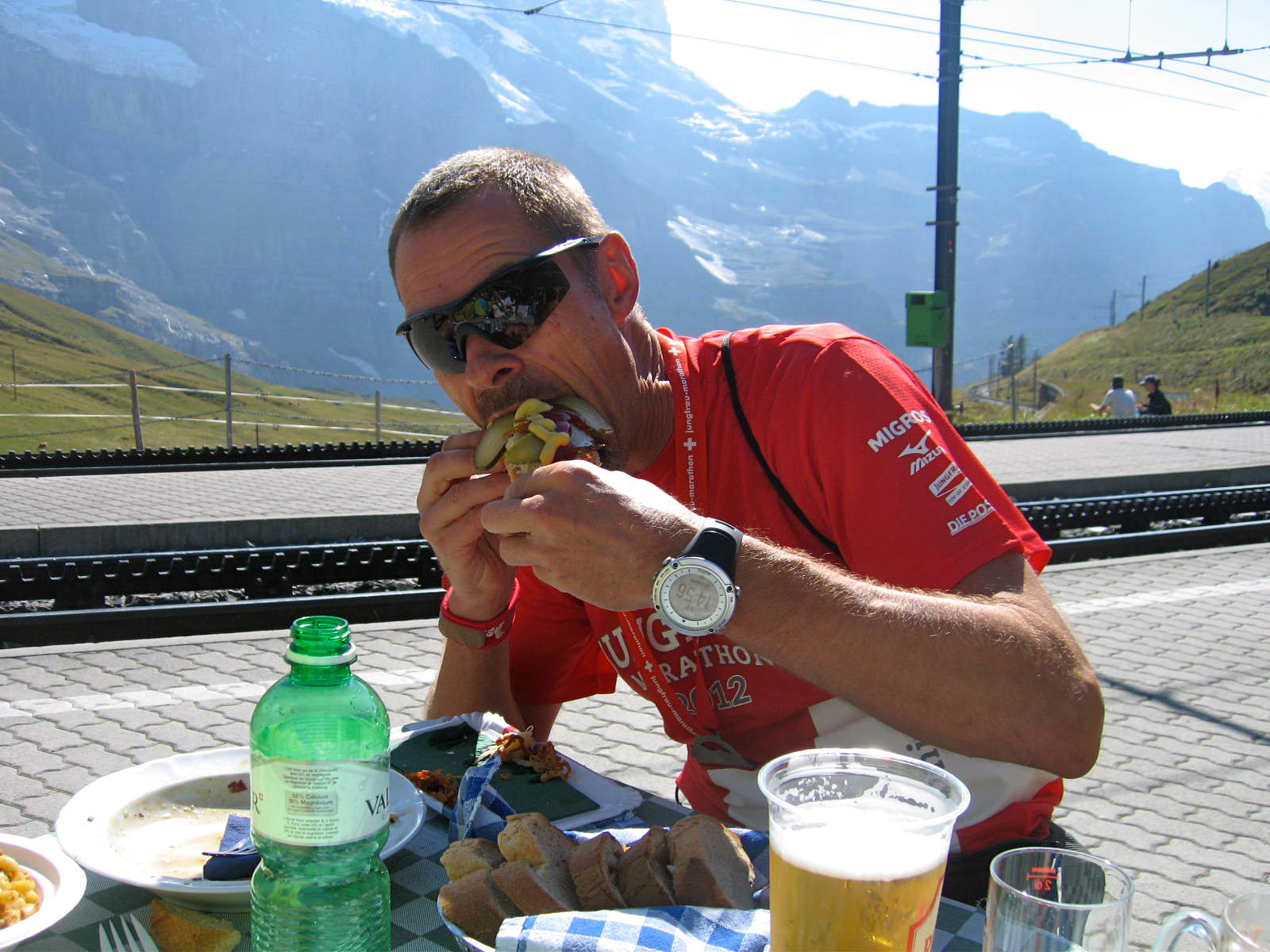
After a refreshing shower, a couple of beers and even a hot dog with sauerkraut, I added a recovery walk/run of 10km down to Grindelwald (but back up with the last train). Next day I woke up without soreness and took the first train to the Jungfraujoch, the highest public train station of Europe, at 3.454m or 11.333ft, topped up by the Sphinx Observatory to 3.571m. This visionary rail-project was already ‘sketched’ in 1893 and opened on 1 August 1912, just over 100 years ago! The train goes straight into the Eiger, the iconic mountain with its brutally steep north-face, the locus of many mountaineering victories and drama’s. I like running mountains and I even don't mind falling but I’m not tempted to climb with hooks and ropes, with a fatal fall only one small mistake away. 

Once up at Jungfraujoch, an arctic underground theme-park ‘Alpine Sensation’ is neatly laid-out for the thousands of visitors, daily. Luckily there is an exit to enjoy the natural beauty of the glacier and the impressive snow and ice capped peaks of the Eiger, Mönch and of course the Jungfrau, with its 4.158m the highest of the three. There was no point in going up there, but there was a nice glacier ‘path’ to the impressive Mönchsjochhutte at 3.650m altitude and I decided to run it. I was positively surprised that running a 5k at this altitude is well possible, but only with a high fitness level, as my fellow-countryman, who also finished the marathon the previous day, experienced to the extent he was forced to return to lower altitude. 

On the way back with the train I stepped of the train at the station Eigergletscher and ran down for another few k’s and 300 vertical meters,  with a very rewarding pause at a glacial lake with bubbling ice-water; the perfect ice-bath for feet and lower limbs. 

All in all, the Jungfrau marathon was a great experience, thanks to the fantastic weather conditions, the perfect organization and of course the natural setting of green meadows, forests, mountain villages and impressive peaks and glaciers. 

***


The Jungfrau marathon was a far better experience than the 100km Olympus Mythical Trail on 7 July, a grueling mountain-trail-race to and around the summit of Greece’s highest mountain (2917m), with 7000m elevation gain in total. Compared to that race, JM is an easy piece of cake! OMT was actually the first race ever I DNF-ed, a feared term among runners meaning Did Not Finish. I’ve quit the race after 62km and 12 hours or so, on raw soles and battered legs. Around 200 experienced mountain runners started this inaugural race at 1am, in rather hot and very humid conditions (I was already sweating before having started). I ran well the first 30-40km and moved up to the leading pack of 20-25 runners. But slightly oversized shoes and single layer socks were the wrong answer to the agonizing conditions of the mountain track, if any. Around 50k my legs and stomach were screaming too, probably due to sweating out too many salts and reaching an alarming state of dehydration, with temperatures weigh above 30C. When I started to hallucinate and see non existing aid stations, I sensed it was pointless to run another 40k and 2000 more vertical meters, which took most other runners between 10 to 14 hours more to cross the finish line (in the middle of the night). Yet, when I noticed that many runners took a recovery-break of one to several hours at the 66km check-point; as well considering that I also recovered well after a while, I probably could finish too, but with the risk of losing the joy of running altogether. On the other hand I was not unhappy to have found my limit and instinctively I know that I will have to push that limit if I want to finish the Spartathlon race end of September. I also learned that running in heat is stressing my body and brain more than I can absorb, so I would have to train more in the heat to make a chance to get through the first leg of the Spartathlon, often facing soaring temperatures. 


On contrary, when I started  the marathon of Torhout on 22 June, better known as the ‘fabulous’ Night of Flanders, and having no intention to run fast so close to the OMT, the cool weather allowed my feet to move at a fairly fast pace, with a 1:28 at the halfway mark, and than slowed down by a strong headwind but still finishing the ‘training’ race in a decent 3:06:33, my average marathon time this year - so far. Apart from the time I was happy to have ran with some of Belgium's finest ultra-runners.

‘Luckily’, there was no shortage of chances to run in more hot conditions after the defying OMT. Finishing my multiple year mission in Kosovo, I returned home on 15 July and when I arrived in Athens the thermometer was peaking 41 degrees Celcius, followed by more bloody hot days and nights. Due to over-exposure to airco’s I fell ill for the first time in very long; probably also a reaction to some hard working weeks and the packing and moving out. Soon came the time to travel to Mesta, on the mastic island of Chios, where we enjoy our yearly summer holidays and where we would baptize our daughter on the 29th of July. In Chios I resumed running, often combined with swimming in pristine bays. On most of these swim/runs I was happy to have my Belgian running friend Lowie as sparring partner, especially for the ‘great Chios run’ criss-crossing half of the island and covering a distance of 77,5 km and 3.200 vertical meters, under a burning sun and 35 degrees. Again I faced problems with the heat, but this time I poured much more water and isotonic liquids into my system. 

Two weeks later I would attempt another ‘great Chios run’ of about the same distance, but suffered much more due to hot and heavy winds, as well the smoke of fast-spreading wildfire that would destroy or damage a bigger part of the southern half of the island - known as the Chios tragedy (with 15.000 hectares of lost forest and cultivation land with world unique mastic trees, causing a massive environmental, cultural and economical disaster to the island and its population).

In between I had the ‘smart’ idea to run the first leg of the Spartathlon, from the Acropolis in Athens to the famous canal of Corinth, 81 km. Two local running friends joined and the first 30-40k went pretty easy. But slowly my brain turned sun-boiled and my legs sun-fried; with a break-down around the 50k-mark. The vista of a turquoise blue sea with a sea-turtle and bathing folks broke my mental resistance completely and I surrendered to a refreshing swim and a walk to the next railway-station at the 57 k mark, while the real tough guys continued and completed the distance. 

Again a lesson in humility! I’ve had to fear for the worse if my Sparta-race would end the same as my Spartan training! On the other hand, one can learn more from mistakes than from successes only. 

Benefiting from mistakes and failures I also what learned from reading stories and books such as ‘Why we run’ from Robin Harvie and ‘Eat & Run’ from ultramarathon greatness Scott Jurek. Interestingly, both authors ran the Spartathlon. Harvie had to DNF after 17 hours and 136 km, while Jurek participated three times and WON three times (2006-2008). Whilst the professional runner Jurek is probably more gifted or talented than the recreational (but obsessive) runner Harvie, Jureks key to finish and win ultra-races is his mental strength rather than his physical strength (only). A strength to push the limits where other runners see no space anymore. To accept lows (and very lows) and gradually climb out of them without panicking. To break down and stand up again. To continue where ‘normal’ people say ‘enough is enough’. Therefore it’s no coincidence that Jurek’s delicious book - full of recipes for healthy running and eating - opens with a quote from William James, a pioneering American psychologist and philosopher who was trained as a physician.

“Beyond the very extreme of fatigue and distress, we may find amounts of ease and power we never dreamed ourselves to own; sources of strength never taxed at all because we never push through the obstruction.”

In his account of his second Spartathlon victory (running on a broken toe), Scott Jurek writes the following:

“What [are] my limits? And how could I discover them unless I tried to go beyond them? (...) It’s a question that every ultrarunner and anyone lucky enough to reach for something outside her comfort zone can ask - and answer - herself.“

If this ‘borrowed wisdom’ will be enough to get me through the lows and run beyond exhaustion is to be seen and experienced. I will give it my best shot on 28/29 September and I feel lucky that I am allowed to start in the 30th edition of one of world’s toughest ultra-races, or to say it with Jurek’s words: to reach for something outside my comfort zone! King Leonidas, here I come!

Frank D’hondt,
20.09.’12, 
Athens


Sunday, May 27, 2012


Spring Running Report


Race report Olympia Ultramarathon


In the foot-steps of the ancient Olympic runners


Yes, I can! I can run 180 kilometers or 112 miles with no stops longer than a couple of minutes, including an elevation gain of 3.700 meters or 12.000 feet. On 19 May at 10:46am, after 20 hours and 16 minutes of running, I happily crossed the finish line of the historical “Olympia Race”. A unique and internationally certified ultra-race connecting the two biggest stadiums of Ancient Greece, from Ancient Nemea to Ancient Olympia, with its eternal Olympic flame, now on its way to London. So far, my longest run was 100km, 3 months ago in Psatha-Alepochori (see my Winter Running Report). On the last day of March, at the old airport of Athens, I tried to run my first 24 hour race in which the athlete tries to cover as much distance as possible. However I ‘dropped out'(1) after about 12 hours and 100km or so, due to knee-pain and a lack of motivation to break through the pain barrier, as I did during the Olympia Race, which is a point-to-point race in a (literally) Arcadian landscape, with no comparison to the concrete ‘desert’ of the 600m lap at Ellenikon airport, the scene of the 24 hour race. The magical Olympic stadium of Olympia worked as a huge magnet to keep me going and pull me to the finish line, right in front of the most historic running track in human history. I do not entirely exclude the possibility of running another 24 hour race (or for good measure a 48 or 72 hour race), but I will have to trick my mind to keep going that long, lap after lap.

Further in the preparation of my first ‘real’ ultramarathon - according to ultrarunning legend Yiannis Kouros, anything below 12 hours of running is not to be considered as ‘ultra’ - and since my Limassol marathon in Cyprus (see Winter Running Report), I also ran the Antwerp marathon (in 3:05) as well as two half marathons, both in Athens in around 1:30. Of course I’ve kept on training nearly daily and threw in a couple of so called Back-to-Back runs - basically a long run on Saturday, followed by another long run on Sunday - but I never exceeded lets say 100km of training per week, which is my ‘normal’ peak training for ‘normal’ marathon racing. In other words, apart from the 100km races, I didn't train excessively more miles than usual, while I tried to keep up with some interval and tempo-training in order not to entirely lose raw leg speed. So in the weeks leading up to the Olympia Race I felt rather undertrained in terms of endurance, but I knew this was to be preferred than being overtrained towards race-day.


So on raceday, 18 May, with fresh legs but uncertain about the feasibility of running that far, I headed to Ancient Nemea, together with 82 runners competing for the 180km race and another 80 or so aiming for the ‘fun-run’ of 62km. While most participants were Greek, 13 other nations were represented, mostly European countries as well as from the USA, Israel and even from Hong Kong/China. I was the only Belgian runner, although I was wearing my Greek club-shirt of “Grigora Kordonia” (“Fast Laces”). In the last edition of the Olympia Race (2010) a Belgian ultrarunner, Wouter Hamelinck, finished 3rd in 22:51. A ranking and time I could only dream of before the start…

After a joint lunch and final briefing all runners gathered in the Ancient Olympic stadium of Nemea, where the first games and runs took place in 573 BC, and with a capacity of around 40.000 spectators. After listening to the Greek national anthem, runners were called one by one to line up. At 2:30pm sharp, we started our epic race, albeit with less spectators and soon leaving the stadium behind us. The tension in my calves soon disappeared and the running became more smoothly mile after mile. The weather was ideal - at least for me: overcast and cool temperatures of around 16 degrees Celsius; unusually low for the time of year. We ran the first 20 km or so on a smooth asphalt road through the famous vineyards of Nemea, one of Greece’s finest wine areas. I knew I had to keep a conservative pace but I find it difficult and rather unnatural to run at a pace below 5:00 per km, or 12 km/h.

After the first 20km, a trail section took us to the top of a hill from where we could enjoy impressive views over a small valley with crops and wild flowers. More dirt tracks followed, of which some rather challenging and climbing to the Olighyrtos Mountain pass at 1.200m altitude, where my friend Dimitris from the organizing committee (and our running club) greeted me. Then there was a fast downhill section to Kandila and CP4 at 48km. From there on a long asphalt road leading to the first big station, the village of Levidi, CP7 after 62km and at 1000m altitude. I arrived in lovely Levidi after 6 hours running in a surprising 4th position; still feeling relatively fresh and strong. Dimitris was very helpful in changing my running gear for the night and I ‘savored’ a plate of pasta with yoghurt, while being massaged by 4 hands while standing. This all took no longer than 5 minutes after which I headed out for the night and to the mountains ahead.

Crossing Mount Menalo and 23 km to the next Check-Point was quite an intimidating challenge after 62km of non-stop running, but I decided to ‘take it as it comes’. While hiking the steeper uphill sections in total darkness and with only my flashlight as companion, I was actually happy to hear 4 faster runners nearing me. They were clearly more experienced ultrarunners and I took the risk to follow and mimic their running style by alternating running and walking on the ascent to Mount Menalo up to 1400m. Yet, three of them were too fast for me and I saw them fading away in the darkness. On the descent to Vytina I was on my own again and was delighted to find my way to CP8 at 84,4 km; leaving the aid-station while spooning a delicious ‘fat’ local yoghurt to keep a base in my stomach.

Once out of the village, glowing light sticks in trees were the only visible markers to find our way, now heading to Magouliana, the highest village of the Peloponnese at 1450 m. It was now getting cold with temperatures dropping as low as 5-6C, so it was time to put on my windproof jacket and gloves. I came through CP9 at 97k in 9:58, still at a good pace and in relatively good shape, however ‘only’ just over halfway. At that point it’s hard to believe you have to keep your legs and feet going for another 83km, so its crucial to think mainly about getting to the next CP. Easier said than done as there was another long unsupported section of 19km between CP 10 and CP 11. It turned out to be one of the longest 19km ever in my running life; it seemed endless and I never felt so lonely on a completely bare mountain with a narrow track full of pebbles and rocks, yet accompanied by billions of stars. It was too cold to drink or eat with a stomach in sleeping mode, and I had to force myself to eat at least some of the tasty and fresh Santorini tomatino’s I had brought with me.

It was 4 in the morning when I finally reached the outskirts of Perdikoneri village, and I thought I was hallucinating when I saw a tall figure with open arms running towards me. Dimitris! My friend also happens to be responsible for CP11, 124 km or two-thirds into the race. He’s the savior of many runners arriving there!  Once more he helped me with refueling and changing gear, this time including fresh socks and shoes. This took a while and required some sitting, but I thought it was important to keep the feet dry and blister-free, which is far from evident in my case (but it worked!).

I anticipated that the last third would be the most difficult part, as I entered completely unknown territory, far beyond my ‘previous’ limits and still many challenging tracks ahead before Olympia. It was good to hear that the next CP was only 3km ahead, so I would certainly make it to that point, and then would see again. At CP12 I asked for a hot tea but it was so hot I had to carry it with me, not to loose precious time. It’s quite a challenge to drink a hot tea while running downhill, believe me. Local people take care of these invaluable aid-stations and have to be praised for their free-of-charge services and support. From there a rough track led to Doxa and further on an easy and charming asphalt stretch I got to Kastraki, CP15 at 145 km.

 Just before the fading of my headlight, a new day started to dawn which recharged my mental batteries to keep me running. I was getting more and more amazed with my own body and mind, as I still had no urge to walk anything other than steep ascents. Just out of the village a trail led to the river Erymantos, hidden by a nebulous bubble due to contact with the cold early morning air. To my great surprise, I over-took two of the three runners that had passed me on Mount Megalos, 70km ago; these were two German runners that had won previous editions of this race. I couldn’t believe it and I guessed that they would probably over-take me again before the finish line. However, I still felt strong and started to believe I could also get back to the third runner who overtook me on Mount Megalo. And indeed, just before crossing the river, I saw him - Konstandinos - on the other side of the second river bank. Just before CP16 in Koklama, I over-too him but at CP16 I had a drop-bag with another pair of dry socks and my beloved minimalist Nike Free 3 shoes - in the (wrong) assumption the last section would be smooth asphalt - to get me through the last 30km. It took me quite a while to change and by that time Dinos, in fourth position, was again out of sight. I had to dig deep to catch up again and for a while we played Tom and Jerry. Sensing that this was a tricky game that far in the race, we silently ‘agreed’ to support each other for the last 25 km, as the distance was stretching out towards the end and the sun started heating up the air and our brains. I believe it was the right decision, as the last 20km were far from easy going; to the contrary.

A long muddy and hilly trail was a real ‘pain in the ass’, especially for the screaming quads that suffered already too many downhill runs. Only our joined will-power propelled us forward and we kept on running relentlessly when not ascending.


After what see  endless we finally reached Mouria, the fore-last CP at 175km. Less than 5km to go but on dead legs and under an increasingly hot sun. More will-power was needed to get those legs running once more after a last pit-stop, but we could still squeeze out a pace of around 5mins per km, or 12km/h,  step-by-step closing the gap to the magical finish line at the entrance of world’s most famous running stadium, in 20 hours and 16 minutes, with my feet crossing the line some feet in front of my co-finisher Dinos, placing respectively 4th and 5th, less than 2 hours after the iron-man winner, Stergios Anastasiadis.

Due to another joint-finish of the second and third runner, we were both ranked at position 3. Very rewarding and simply amazing! I started the race with no other ambition than to finish and maybe to finish in around 24 hours, and could simply not imagine to finish on the podium in a time 8 hours in advance of the cut-off time. The crowning with a wild olive tree wreath, the same as for the ancient Olympic victors, made me feel like a modern Olympian athlete.  

Aethlios was the first king of Ilis, an area of ancient Olympia, son of Zeus and Protogenia. Aethlios became the protector of the races in Olympia and from his name came the word ‘athlete’ to define the endless endeavor of man to conquer his natural barriers. That day in May, at the Holy Temple of Athleticism, I certainly pushed my limits far beyond my own imagination and dared to believe that I could run beyond this new barrier. Out of the 83 Olympia runners, 58 finished within the 28 hour time-span. The previous winners finished nearly one hour later than Dinos and I did, and only 13 runners finished below 24 hour, of which the first female runner, Amalia.

The award ceremony, the 4-star hotel with swimming pool, the dinner and the visit to the Olympia museums and a winery in Nemea over the following days were all very nice, but my supreme moment of joy was the popular party in the town-hall of Nemea with local food, wine, dance and above all my wife and daughter, my foremost important power-stations.

Stiffness in the legs only lasted for 2 days and I resumed light training on day 3. A good race apparently results in a smooth recovery. Although knee-pain occurred about halfway into the race, knee-support helped me through and it didn't cause any lasting injury. It was good to be prepared for the worst to happen, including pre-taping my feet to keep them blister-free, which - to my sheer joy - worked very well, even better than in most of my ‘normal’ marathons and certainly better than in my first 100km race. Another lesson learned was that it’s good to run according to your feeling and not according to an anticipated race-strategy or race-pace. I also learned that heading out pretty fast does not necessarily have to backfire later in the race, as long as you take it relatively easy on the uphill sections. Although I intended to run with a heart-monitor, I was actually lucky that I took it off just before the race, as the battery was depleted. Wearing the monitor, I might have been over-cautious and may have unnecessarily held back or become stressed about a low heart-rate. Nutrition-wise - a big concern during my previous ‘ultra’s - I finally found a better balance between isotonic drinks and ‘real’ food such as pasta, tomatoes and the ever-delicious Greek yoghurt, even in the middle of the night. Also, water with gas and coke helped to trigger the stomach. Candied ginger helped to calm my gut when needed. The only point of further attention is the upper body, with too much tension in my neck, shoulders and lower back, so I should learn to run more relaxed and loosen up from time to time.

Running a real ultra is so much more than running a race; its more like a journey, paraphrasing the great Dutch ultrarunner Jan Knippenberg. A journey to discover the Arcadian landscapes, as well a journey to discover your own body- and mindscapes. Ultra-running definitely requires a healthy - if not a slightly obsessive - mind to command a well trained body. I believe this is the true spirit of an Olympian athlete, ancient and modern.

 As I already said, I resumed training for my next goals. On 22 June I will run the marathon of Torhout, better known as the ‘fabulous’ Night of Flanders, with also a ‘popular’ and fast (but sadly "last") 100km run. Although I’m tempted to run the famous 100km of the Night of Flanders, I will save my energy for the 100km Olympus Mythical Trail on 7 July, a grueling mountain-trail-race to and around the summit of Greece’s highest mountain (2917m), with 6700m elevation gain in total. This one might turn out to be more challenging than the Olympia race. Only mighty Zeus knows as I will be among the first humans to try it (first-time race). Check it out on I just hope I will be timely recovered for the baptism of our baby girl on 29 July in Mesta/Chios. On 9 September I will compete in the Jungfrau-marathon in Switzerland, as the last training before the ultimate challenge of this running season, the Spartathlon on 28 September, which according to many is “the toughest race on earth”, covering 246km in a maximum of 36 hours.

Zeus, here I come!

Frankly Runner

PS: special credits go to the organizers of this great Olympia Race and in particular to Sotiris, Anastasia and Vicky; to Jan from the International Association for Ultrarunning (IAU)- not only for their positive energy throughout this event but also for a great race photos; to my friend Dimitris and other running friends of Grigora Kordonia (“Fast Laces”) for their support; to the new friends I have made during this race - Chris and Dinos in particular - and last but not least to my family for their endless support.


[1] Interestingly, technically you don’t drop out of a 24 hour race as the only thing that counts is the distance covered in 24 hours, no matter how long you actually run. That’s why I also ended up in the ‘finishers’ with ‘only’ 96,5 km, but which still placed me far away from the last place. As a matter of fact, I ran the first 60km or so in the first position; a clear indication of heading out too fast, also given the sun and heat during the first 6 hours of the race. At least there was a lot to learn from this event.